
If AI needs to choose, does it have to write?
A request arrives at a company: “I need a copy of my invoice.” Who should receive it: support, accounting, or sales?
This step doesn’t necessarily require a long answer. It requires identifying the right department. This simple distinction helps explain Jev and CLM-8B: two examples of AI models designed to evaluate options and return a choice that software can use.
Writing and choosing are different tasks
A generative model, like those behind many AI assistants, can write a response, summarise a document, or explain a topic. It is useful when the output we need is text.
But when the question is “Which department should receive this request?”, the software may only need the department’s name. A decision model can evaluate predefined alternatives and return a result, without the software having to extract it from a paragraph.
A generative model can also be configured to return a choice. The distinction we are interested in concerns the task: producing text or evaluating a defined set of options.
Jev and CLM-8B, in simple terms
Jev, by TypeSafe AI, receives information and predefined questions. It can return a choice, a score, or a probability for a yes/no question. For example, software could ask it which department should handle a request, providing the alternatives and criteria.
CLM-8B, from the Contrastive-LM project, is an open-source project: its code is available to inspect. It compares a described situation with possible actions and assigns scores to select an option.
They point in a similar direction, but they should not be considered identical. To understand whether they suit a business process, they need to be tested on real requests and on the types of errors that matter in that context.
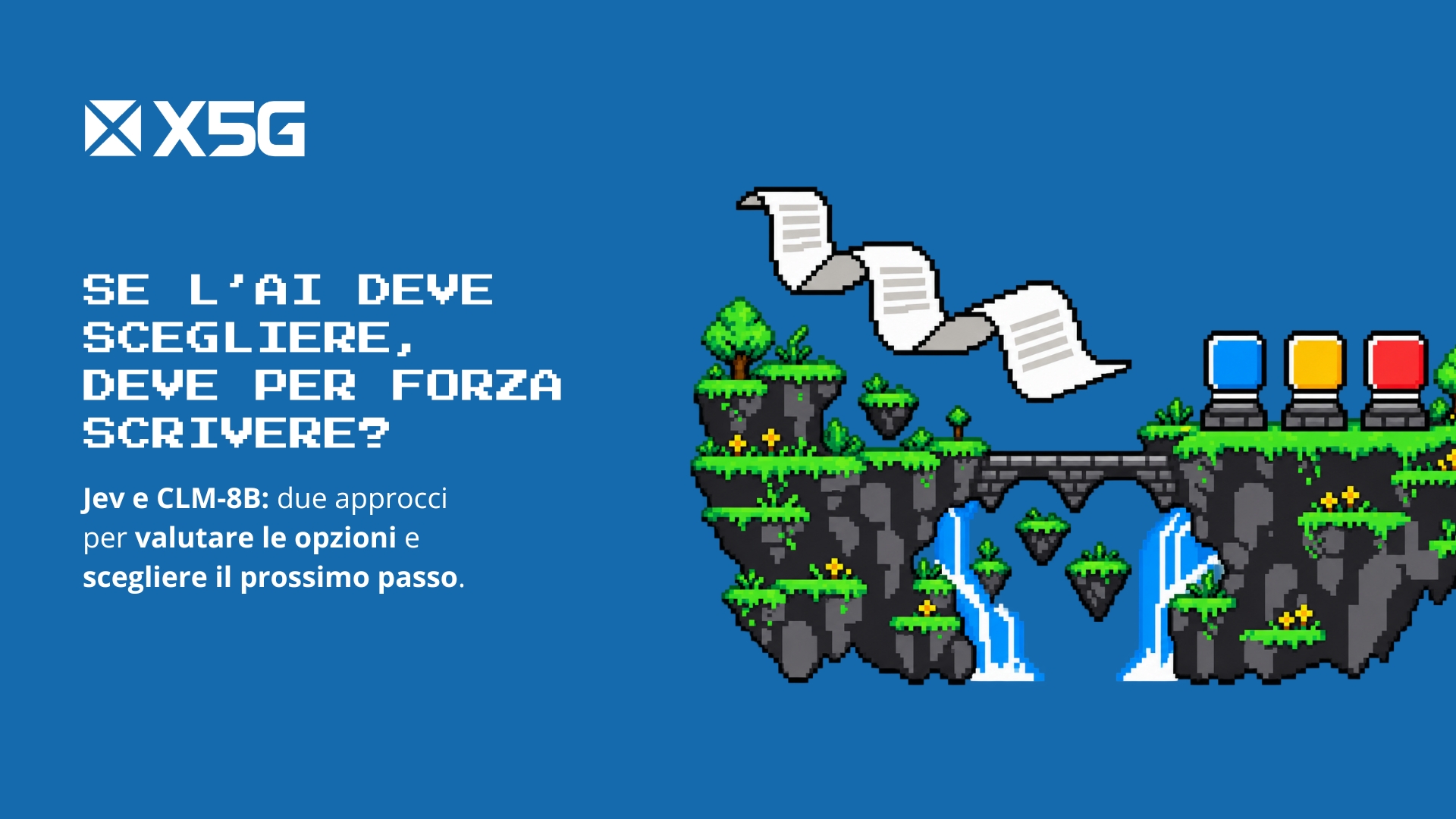
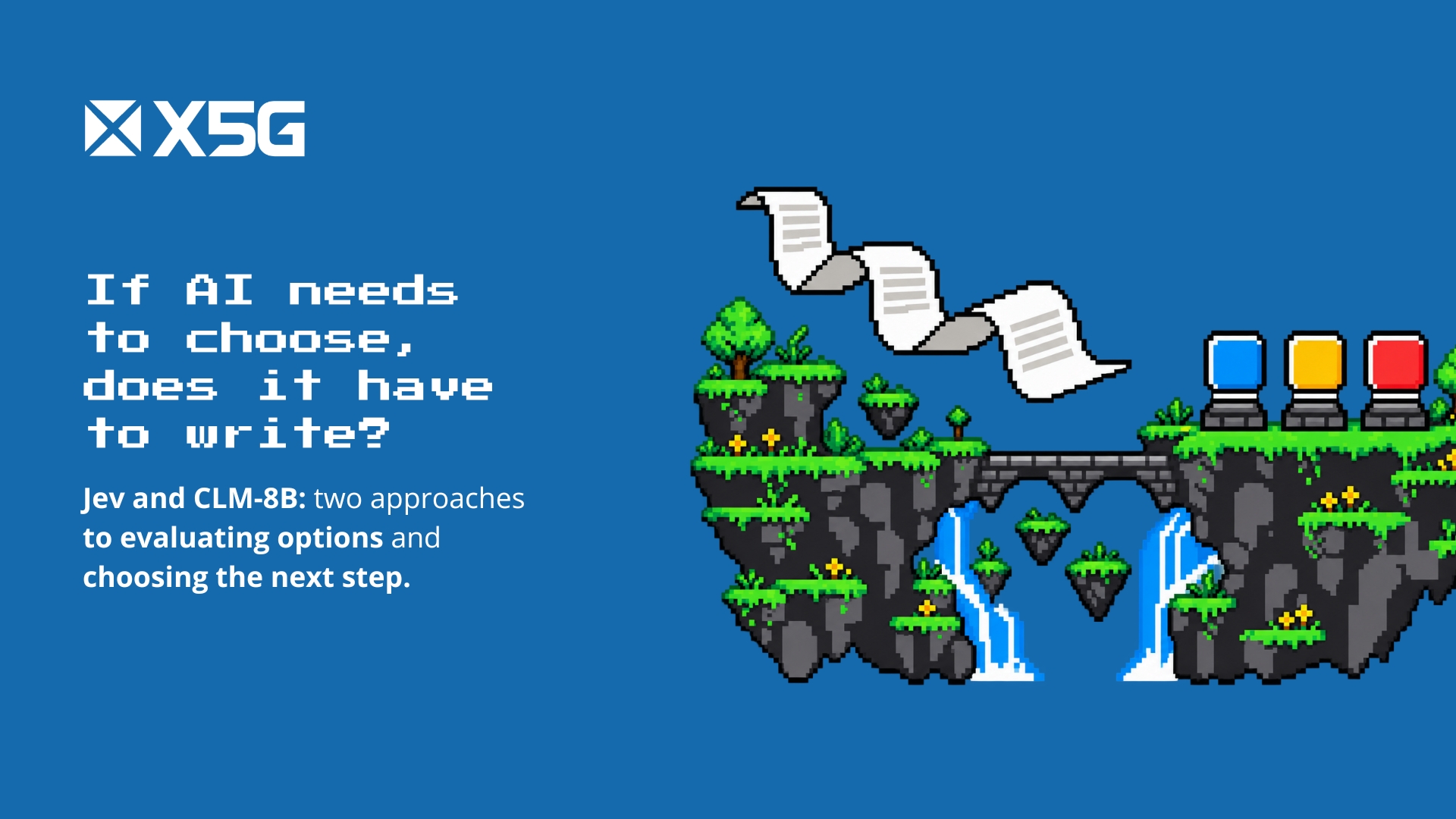
Imagine the next move in a game
A character reaches an obstacle. The available moves are to move forward, jump, or wait.
In a hypothetical example, the system could work like this:
- A component capable of interpreting images describes the scene: “There is an obstacle in front of the character.”
- The software prepares the permitted moves.
- The decision model evaluates the alternatives based on that description.
- The software executes the move and observes what happens next.
Interpreting the image, choosing a move, and executing it are separate steps. In the documentation consulted, Jev accepts text; image support for CLM-8B is listed as a future development. Our example therefore requires a separate visual component: it is not a demonstration of these models playing a game on their own.
Where could this be useful in a business?
The same reasoning can help identify steps worth evaluating: choosing which department should receive a request, assigning a priority, or selecting a tool from those available.
These are possibilities to investigate, not results already achieved by X5G. A concrete question comes first: are the alternatives clear enough? And do we know what to do if the model makes a mistake or the result is uncertain?
The software must define which actions are permitted, how to use the response, and when to require human review. A choice returned by AI is not automatically correct.
Which step should you start with?
You can start with a specific decision, compare the model’s responses against cases already assessed by people, and determine whether the result is useful.
Writing a reply to a customer may call for a generative model. Deciding which department should receive the request may be a suitable task for evaluating a decision model. The two tools can work together.
In your work, which repetitive step requires a clear choice more than a long answer?
For those who want to explore further
CLM-8B uses separate numerical representations of the situation and the actions to compare them; the documented implementation is based on Qwen3-8B.
The team reports latency advantages over Jev in its own tests. These are measurements from the project, not guarantees for every application: speed and decision quality must be tested for the specific use case.
For Jev, we describe the documented features without assuming it shares CLM-8B’s architecture. For both, the quality of the information provided, the process rules, and error handling matter.